
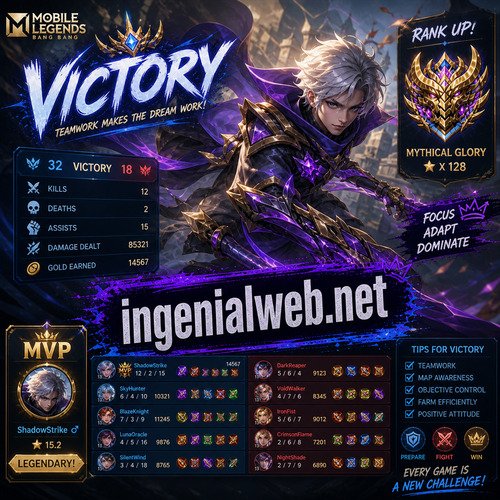
ingenialweb.net – Mobile Legends: Bang Bang is a game where every stage of a match presents a different challenge. The opening minutes are often about securing resources and establishing safe lane control, the middle stage focuses more heavily on rotations and objectives, while the late game demands discipline because a single mistake can completely change the result. Although mechanical skill is important, players who want to improve consistently need to understand the strategic side of the game as well. Knowing when to farm, when to rotate, when to fight, and when to retreat can have a greater influence on the final result than simply having fast reactions. Mobile Legends rewards players who can recognize opportunities before they become obvious and avoid situations that provide the enemy with unnecessary advantages. A player does not need to dominate every lane to contribute to a victory. Sometimes the most valuable contribution is quietly collecting resources, defending a turret, providing vision, or creating pressure that allows another teammate to succeed. The key is understanding how individual actions affect the entire map. Once players begin to see the match as a connected system rather than a series of isolated fights, they can make better decisions and become more consistent regardless of the hero they choose.
Developing Strong Fundamentals for Every Match
Farming is one of the most basic parts of Mobile Legends, but efficient farming requires more awareness than simply defeating as many minions and monsters as possible. Gold and experience determine how quickly a hero reaches important power points, so losing resources unnecessarily can create a disadvantage that becomes difficult to overcome later. Players should learn to collect minion waves consistently while also considering what is happening elsewhere on the map. Staying in lane too long may allow the enemy team to secure an objective without opposition, while rotating constantly can cause your own hero to fall behind. The ideal balance changes depending on the role and stage of the match. A Gold Laner usually benefits greatly from safe and consistent lane farming, while a Jungler needs to maintain efficient movement between camps and objectives. Other roles may have greater freedom to sacrifice some farm in exchange for supporting teammates. Farming also involves understanding when a resource is worth taking. Walking across the entire map for a small camp can waste more time than the reward provides, especially when a wave is approaching your turret. Efficient players try to reduce empty movement. If you are traveling toward another area, consider whether you can collect a nearby resource along the way without missing something more important. The goal is to make each movement productive. At the same time, farming should never become an excuse to ignore danger. A large amount of gold means little if the player repeatedly dies while trying to collect it. Safe farming combined with map awareness allows a hero to scale without giving the opponent easy opportunities. Over time, players begin to understand the rhythm of resource collection and learn how to balance income with team responsibilities.
Using the Minimap as a Constant Source of Information
Map awareness is one of the strongest skills a player can develop because it influences almost every decision. The minimap provides information about enemy positions, allied locations, lane conditions, turrets, and potential threats. However, simply looking at the minimap occasionally is not enough. Players need to develop a habit of checking it before making important movements. If an enemy disappears from a lane, assume they may be rotating toward another target. If several opponents are visible far away, you may have a safe opportunity to push or collect resources. If your teammate is moving toward an objective while several enemies are missing, you may need to provide assistance instead of continuing to farm. This constant flow of information allows players to make decisions before problems occur. Map awareness also helps predict enemy intentions. For example, if an opponent clears a wave and disappears toward the river shortly before a major objective becomes available, it is reasonable to suspect that they are preparing for that objective. You do not need perfect information to make a useful prediction. Good players work with probabilities. They consider what the enemy is most likely to do and position themselves accordingly. This makes gameplay feel more controlled because you are no longer reacting to every surprise. The minimap should also influence how aggressively you position your hero. A player can safely move farther forward when most enemies are visible elsewhere, but should become cautious when multiple opponents disappear. Developing this habit may feel difficult at first because it requires repeatedly shifting attention between your hero and the map. Eventually, however, it becomes automatic and can dramatically reduce unnecessary deaths.
Understanding Equipment and Adapting to Threats
Equipment choices are another area where players can gradually improve their decision-making. Recommended builds are useful because they provide a basic starting point, but they should not be treated as permanent rules. Every match contains different threats, and equipment should reflect those circumstances. If the opposing team has strong physical damage, defensive options that reduce the impact of physical attacks can become valuable. If magic damage is the major threat, appropriate magical defense may allow your hero to survive longer. Crowd control can also influence equipment decisions because surviving an important control effect may determine whether a hero can contribute during a teamfight. Offensive equipment requires similar consideration. More damage is not always the best answer if the enemy has strong defenses or if your hero is dying before having enough time to attack. Players should think about what prevents them from accomplishing their role. If a Marksman has enough damage but constantly gets eliminated by divers, additional survivability or positioning adjustments may produce greater value than another pure damage item. If a Fighter cannot reach the enemy backline safely, movement or durability may be more useful than simply adding attack power. Equipment decisions become much easier once players understand their purpose rather than memorizing names. Instead of asking which item is considered popular, ask what problem the item solves. This approach creates flexibility and makes players less dependent on fixed builds. It also helps when facing unusual team compositions or unexpected situations. A strong build is not simply one that looks powerful on paper; it is one that allows the hero to perform its intended role effectively against the specific opponents in the current match.
Controlling the Middle of the Match Through Better Decisions
The middle stage of Mobile Legends is often where the match becomes more dynamic. Turrets begin to fall, players move more frequently between lanes, and objectives become increasingly important. This is the stage where rotations can have a huge influence. A rotation should usually have a purpose. You may want to help a teammate, defend a turret, contest an objective, invade enemy resources, or create pressure on another side of the map. Moving without a purpose can waste valuable time and cause your own lane to become vulnerable. Before rotating, check whether the current wave needs attention and whether your destination is likely to provide a meaningful opportunity. Timing is especially important. Arriving early can allow you to establish a strong position, while arriving late may leave you walking into an already lost fight. Players should also learn to recognize when not to rotate. If a teammate engages in a fight that is already clearly unfavorable, joining them may only create additional deaths. Sometimes the better decision is to take resources elsewhere or defend a structure. This requires discipline because players naturally want to help teammates whenever combat appears. However, strategic teamwork is not the same as blindly following every engagement. A good rotation improves the team’s overall position. It should create more possibilities than it removes. Over time, players learn to evaluate rotations through expected value: what can be gained, what can be lost, and whether the timing makes sense. This mindset reduces wasted movement and helps teams arrive at important moments with more resources and better positioning.
Creating Pressure Without Constantly Fighting
Many players associate pressure with attacking enemy heroes, but pressure can exist without direct combat. A pushed lane, controlled jungle area, or strategically positioned hero can force opponents to react. This is important because forcing the enemy to respond creates opportunities for your team. For example, if one player maintains pressure in a side lane, an opponent may have to leave the center of the map to defend. That movement can create an opening around an objective. Similarly, controlling an area around a major objective can discourage the enemy from entering safely. Pressure is therefore partly about limiting choices. The opposing team should feel that certain movements are dangerous or costly. However, pressure needs to be applied carefully. Pushing too far without information can expose the player to a collapse. Staying too passive can allow the enemy to control the map instead. The strongest approach is usually to combine pressure with information. Before moving deep into enemy territory, check which opponents are visible and which are missing. If several enemy heroes are clearly shown on the opposite side, the risk may be lower. If multiple opponents suddenly disappear, retreating to a safer position may be wiser. Players should also recognize that pressure can be exchanged. If the enemy pushes one side of the map, your team may respond by taking something on the opposite side rather than trying to defend everything simultaneously. This creates a strategic balance where both teams attempt to gain the most value from available space. Understanding this concept helps players avoid unnecessary fights and makes their movement more meaningful.
Preparing for Team Fights Before They Start
Teamfight preparation often determines the outcome before the first ability is used. Players should enter important engagements with enough health, appropriate equipment, and key skills available whenever possible. Positioning also matters before the fight begins. Frontline heroes should identify where they can create space, while damage dealers should find positions that allow them to contribute without becoming immediate targets. The team should also understand where the enemy is likely to approach from. Fighting near an objective without controlling nearby pathways can make the team vulnerable to a sudden initiation. Preparation may involve clearing a nearby lane, checking an area for enemies, or waiting for teammates to arrive. The goal is to make the battlefield more favorable before combat begins. Players should also monitor important cooldowns. If the team’s main initiation tool is unavailable, forcing a fight may be unwise. Similarly, if a dangerous enemy ability has already been used, your team may have a temporary window to engage. These timing windows are often difficult for beginners to recognize because they require awareness of more than one hero. With experience, however, players learn to notice which abilities have the greatest impact. Team fights become less about randomly pressing skills and more about creating favorable sequences. A successful engagement often begins with one player creating an opening, another controlling a target, and damage dealers taking advantage of the space created. Preparation makes these sequences more likely.
Protecting an Advantage After Getting Ahead
Getting ahead in Mobile Legends can feel comfortable, but a lead is not permanent. Teams can lose an advantage through unnecessary deaths, poor positioning, or excessive confidence. Once ahead, the priority should shift toward increasing control while reducing opportunities for the opponent to recover. This may involve controlling objectives, managing waves, taking safe enemy resources, and maintaining strong positioning. Players should avoid chasing opponents too far simply because they believe they are stronger. A team with a large lead can still lose if several members are eliminated simultaneously. Protecting the advantage requires patience. If the enemy is trapped inside their base, there may be little reason to take a risky fight outside the team’s control. Instead, pressure can be maintained through lanes and objectives until the opponent is forced into an unfavorable decision. This approach reduces the number of comeback opportunities. Players should also continue farming efficiently even when ahead. Strong teams do not stop collecting resources simply because they have a lead. They use the additional map control to gain resources more safely while denying the opponent similar opportunities. This creates a widening difference in strength. The important principle is controlled growth. Every successful action should make the next action easier. If a turret falls, use the new space to control another area. If an objective is secured, use the pressure it creates to push lanes. If an enemy is forced back to base, take advantage of the temporary numerical freedom. This creates a chain of advantages that eventually makes the enemy unable to defend every threat.
Finding Comeback Opportunities When Behind
Being behind does not automatically mean the match is lost. Comebacks happen when the leading team makes mistakes or when the losing team finds a way to create favorable situations. When behind, players should avoid taking unnecessary fights simply because they want to recover quickly. Instead, they should search for safe sources of gold and experience while looking for mistakes from the opponent. Overextended enemies can sometimes be punished, especially when they move without sufficient information. Defending turrets and clearing waves can also buy time. The goal is to reduce the opponent’s ability to convert their lead into a decisive victory. Players should pay attention to enemy positioning. A strong team may become vulnerable if its members spread too far apart while farming. Catching one isolated opponent can create a temporary numerical advantage that allows your team to regain control of an objective or lane. However, comeback strategies require discipline because the margin for error is smaller. A failed engagement may make the situation even worse. Players should therefore prioritize high-value opportunities and avoid low-probability plays. The team should also communicate through signals and movement. If several enemies are visible on one side, teammates may have an opportunity elsewhere. If an important enemy ability has been wasted, that may create a window to defend more aggressively. A comeback is usually built through several smaller successes rather than one dramatic moment. Safe farming, successful defense, isolated picks, and well-timed objectives can gradually close the gap.
Creating a Personal Improvement Routine
Long-term improvement becomes easier when players develop a routine for evaluating their own performance. Instead of entering every match with the vague goal of winning, choose a specific aspect of gameplay to focus on. One session might emphasize minimap awareness, while another could focus on lane management, objective timing, or teamfight positioning. This approach allows players to notice progress more clearly. After a match, consider what happened during the most important moments. Did you arrive late to an objective? Did you rotate without clearing your lane? Did you use an important skill too early? Did you chase an enemy instead of taking a turret? Questions like these reveal patterns. Once a pattern appears repeatedly, it becomes a clear target for practice. Players should also learn from successful games rather than only studying losses. A victory may contain good decisions worth repeating. Perhaps you recognized an enemy rotation early, prepared an objective before the opponent arrived, or positioned correctly during a difficult teamfight. Understanding why something worked is just as useful as understanding why something failed. Mechanical practice can then be combined with strategic practice. A player can train skill combinations while also learning when those combinations should be used. This creates a more complete form of improvement. Over time, good decisions become habits rather than conscious calculations. The player begins to check the minimap naturally, recognize dangerous positions automatically, and understand when an objective is more valuable than another elimination. That gradual development is what makes gameplay more consistent.
Conclusion Mobile Legends Guide: How to Improve Farming, Map Awareness, Teamwork, and Match Control
Mobile Legends rewards players who can combine mechanical execution with awareness, timing, and strategic decision-making. Farming efficiently creates resources, map awareness protects those resources, rotations turn them into pressure, and objectives transform pressure into progress. When players understand these connections, they can contribute to their team even when they are not dominating every fight.
The most important step toward improvement is learning to play with a purpose. Do not fight simply because an enemy is nearby, rotate simply because another lane is active, or chase simply because an opponent has low health. Consider what the action will accomplish and whether the risk is worthwhile. When ahead, protect the advantage and gradually expand control. When behind, remain patient and search for opportunities to recover. By developing these habits, learning from mistakes, and adapting to every match rather than following one fixed routine, players can become more consistent and gain a deeper understanding of how to play Mobile Legends effectively.
