
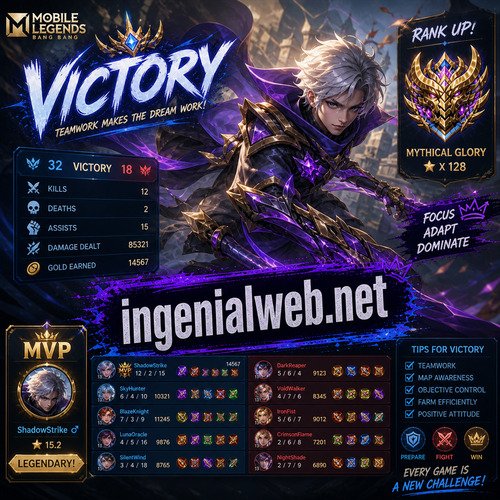
ingenialweb.net – Mobile Legends: Bang Bang continues to dominate the mobile gaming scene because it offers competitive gameplay that is easy to start but challenging to master. New players often join because the game is free, matches are relatively short, and the controls feel intuitive on a smartphone. However, once they begin climbing ranked tiers, they discover that Mobile Legends is far more than a simple action game. It requires strategic thinking, teamwork, and constant adaptation.
Every match feels like a new test. Even if a player uses the same hero repeatedly, the outcome can change based on teammates, enemy drafts, and decisions made during the first few minutes. That is what makes Mobile Legends exciting. It rewards players who learn not just how to control a hero, but also how to understand the bigger picture of the battlefield. Knowing how to fight is important, but knowing when and why to fight matters even more.
Understanding the Main Systems That Shape Every Match
A common misunderstanding among many players is the belief that getting the most kills guarantees victory. In reality, kills are only a means to create opportunities. The actual goal is to destroy the enemy base, and everything else should support that mission.
When players eliminate opponents, they create windows to take objectives. This could mean destroying a turret, taking Turtle, or securing Lord. If a team wins a fight but does not use the opportunity to pressure the map, the advantage often fades quickly. Meanwhile, another team may have fewer kills but win because they constantly push lanes and focus on objectives.
This is why strong players always think beyond combat. They evaluate what can be gained after each fight. Instead of chasing one enemy across the map, they may choose to push a turret because structural damage provides long-term control.
Why Hero Roles Matter So Much
The role system in Mobile Legends is designed to create team synergy. Every role has strengths and responsibilities that affect how the match unfolds.
Tanks act as protectors and initiators. Their job is to absorb damage and create space for the team. Fighters usually control the EXP lane and provide balanced offense and defense. Assassins are highly mobile heroes who focus on eliminating priority targets. Mages offer magical burst damage and crowd control. Marksmen scale into the late game as consistent damage dealers. Supports assist allies with healing, shielding, or utility.
Choosing heroes without considering team balance often leads to major weaknesses. A team with no front line may struggle to survive late-game fights. A team with too many fragile heroes may collapse under coordinated pressure. Players who understand role interactions can make better hero choices and adapt to team needs.
Farming Determines Power
Farming is the foundation of hero progression. Gold and experience allow players to purchase items and strengthen their abilities. Even a small difference in resources can create a huge gap in combat effectiveness.
Players should prioritize efficient farming from the beginning of the match. This means clearing minion waves on time, securing jungle camps when possible, and avoiding unnecessary deaths that give the enemy additional gold.
A common mistake is constantly joining fights at the expense of farming. While helping teammates can be useful, falling behind in items can make a hero ineffective later. Strong players balance aggression with resource management. They know when to fight and when to focus on scaling.
Strategic Skills That Separate Good Players from Average Ones
The minimap is one of the most important tools in Mobile Legends. It provides information that can change decisions instantly. Players who ignore it often become easy targets because they fail to notice enemy movement.
Checking the minimap frequently reveals missing enemies, potential ambushes, and safe opportunities to push. If the enemy jungler appears in another lane, your position may be safer. If multiple enemies vanish from sight, there is a strong chance they are rotating for a gank.
Developing minimap awareness takes repetition, but it quickly becomes one of the strongest habits a player can build. Skilled players glance at it constantly, allowing them to make proactive decisions rather than reactive ones.
Rotation and Controlling Tempo
Once the early game transitions into mid-game, rotation becomes essential. Rotating means moving to another area of the map to support allies, secure objectives, or apply pressure.
Mid laners often rotate first because their lane position allows quick movement to both side lanes. Roamers and junglers also play a major role in controlling tempo through coordinated movement. When players rotate effectively, they create temporary numerical advantages that lead to kills or objective captures.
Good rotation requires timing. Moving too early may waste time, while moving too late may miss the chance to help. The best players understand when their presence will have the greatest impact and move accordingly.
Positioning in Team Fights
Team fights are often the most decisive moments in Mobile Legends. In late-game scenarios, one mistake can determine the winner. Positioning becomes crucial because every hero has a role to fulfill.
Marksmen and mages should stay behind the front line while dealing damage safely. Tanks and fighters need to protect allies and control enemy movement. Assassins should wait for the right opening rather than diving in immediately.
Target priority is equally important. Attacking the closest enemy is not always the best choice. Eliminating the enemy marksman or mage may provide far more value. Strong players understand which targets must be neutralized first and position themselves accordingly.
Expanding Your Hero Pool
Many players become attached to one hero, but relying too heavily on a single character can limit improvement. Learning multiple heroes provides greater flexibility and deeper understanding of the game.
Knowing how different heroes function also improves awareness. A player who understands an enemy assassin’s combo can position more safely. A tank who knows the range of a mage’s crowd control can engage more effectively.
A broader hero pool also helps during drafting. Flexible players can fill missing roles and create stronger team compositions, making them more valuable in ranked matches.
Adapting Items and Strategy
Recommended builds are useful, but they are not always optimal. Each match has unique conditions, and adjusting item builds can create major advantages.
If the enemy has strong healing, anti-heal items are necessary. If they rely heavily on physical burst, armor becomes more valuable. Against magic-heavy teams, defensive magic resistance may be critical.
Adaptation also applies to overall strategy. Some games reward aggressive snowballing. Others require patience and defensive play. Players who adapt quickly are often more consistent than those who force the same style in every match.
Building a Strong Mindset
Mental discipline is a major factor in Mobile Legends. Matches can become frustrating, especially when teammates make mistakes. However, emotional reactions often lead to poor decisions.
Players who stay calm are more likely to recognize comeback opportunities. They avoid unnecessary arguments and maintain focus even when behind. Many matches that seem lost can still be won through careful defense and one successful team fight.
A healthy mindset also means learning from mistakes. Instead of blaming teammates, strong players analyze their own decisions. They ask how they could position better, rotate earlier, or manage resources more effectively.
Conclusion Mobile Legends Gameplay Guide: How to Play Smarter, Rank Up Faster, and Understand Every Match
Mobile Legends is much deeper than it appears at first glance. While its controls are simple, the game’s strategic complexity makes every match a learning experience. Players who focus only on combat often struggle to improve, while those who understand objectives, map control, and team coordination tend to climb more consistently.
Becoming a stronger player requires mastering many interconnected skills. Farming, rotations, positioning, hero knowledge, and mental discipline all contribute to success. No single skill guarantees victory, but together they create a solid foundation for long-term growth.
The best way to improve in Mobile Legends is to play with awareness. Treat each match as an opportunity to learn rather than just a contest of kills. By focusing on objectives and understanding the strategic layers of the game, players can rank up more effectively and enjoy the game at a much deeper level.
