
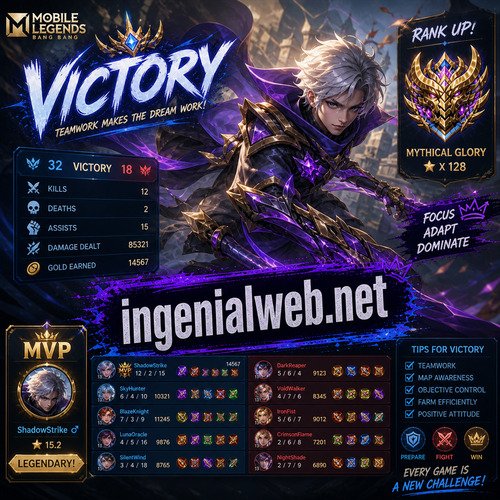
ingenialweb.net – Mobile Legends is a game where hero selection is only the beginning of a much deeper strategic layer. Every hero carries a specific identity that influences how a match develops, from early lane pressure to late-game team fights. Some heroes are designed to snowball quickly, others are built to scale into unstoppable late-game forces, while many exist to control space, protect allies, or create openings through timing and coordination.
What separates casual play from high-level performance is not just knowing what a hero can do, but understanding when to do it. A perfectly timed engage can win a fight instantly, while a mistimed skill rotation can cost an entire objective. This is why Mobile Legends rewards not only mechanical skill but also awareness, patience, and decision-making.
As players climb into higher ranks, the game becomes increasingly strategic. Rotations become calculated, team fights become structured, and every mistake is punished more heavily. At this level, heroes are no longer just characters—they become tools that serve a larger team plan.
Heroes That Shape Matches Through Pressure and Control
Certain heroes are capable of controlling the pace of the game so strongly that the entire enemy team must adjust their strategy around them. These heroes often dominate both solo queue and competitive play when used correctly.
Selena is a hybrid assassin-mage who excels at controlling vision and punishing enemies with long-range stuns. Her Abyssal Trap mechanics allow her to dominate bushes, river entrances, and jungle pathways, creating constant pressure across the map.
What makes Selena dangerous is not only her damage but the psychological pressure she creates. Enemies are forced to avoid certain areas of the map, limiting their rotations and slowing down their farming efficiency.
In the early game, Selena plays aggressively, rotating between lanes and placing traps in high-traffic areas. A successful Abyssal Arrow stun can instantly lead to kills and early snowball advantages.
In the late game, Selena becomes a pick-off specialist. She does not need to fully commit to fights; instead, she creates opportunities by catching enemies out of position and turning fights into numerical advantages.
Uranus and His Endless Sustain Pressure
Uranus is a tank-fighter hybrid known for his incredible regeneration and ability to survive extended fights. His passive allows him to continuously recover HP, making him extremely difficult to eliminate without coordinated damage.
Unlike burst-oriented heroes, Uranus thrives in long engagements where he can slowly wear down enemies while sustaining himself. This makes him especially strong in split-push and front-line disruption roles.
In the early game, Uranus focuses on EXP lane stability and absorbing pressure. He does not need to win lane aggressively; instead, he aims to outlast opponents.
In team fights, Uranus becomes a disruptive frontline presence. He absorbs damage, zones enemies, and creates space for his team’s damage dealers to operate freely.
Mathilda and Her Hybrid Support Mobility
Mathilda is a unique support-assassin hybrid who excels at providing mobility and initiation support for her teammates. Her Guiding Wind ability allows allies to engage or disengage quickly, making her extremely valuable in coordinated plays.
What makes Mathilda special is her ability to enable aggressive strategies without exposing her team to unnecessary risk. She can turn slow rotations into sudden dives or help teammates escape dangerous situations instantly.
In the early game, Mathilda focuses on roaming and assisting the jungler. Her mobility allows her to influence multiple lanes very quickly.
In the late game, Mathilda becomes a key enabler for team fights. A well-timed engage can decide whether a fight is won or lost, especially when combined with high-burst teammates.
Core Roles That Define Competitive Structure
Every hero in Mobile Legends belongs to a role that determines their responsibilities in a match. Understanding these roles is essential for building synergy and executing strategies effectively.
The jungle role controls the tempo of the entire match. Junglers like Ling, Nolan, and Lancelot are responsible for farming efficiently, securing buffs, and creating early pressure through rotations.
A strong jungler can dictate how the game is played by forcing fights, invading enemy jungle, and securing objectives. Poor jungle decisions, however, can lead to a complete loss of map control.
The jungle role is often considered the most impactful because it directly influences early momentum and objective control.
EXP Lane Role and Mid-Game Strength Development
The EXP lane is typically occupied by durable fighters such as Uranus, Yu Zhong, or Paquito. These heroes are responsible for sustaining lane pressure and becoming strong mid-game fighters.
EXP laners must balance aggression and survival. Winning trades allows them to gain control over rotations and contribute more effectively during team fights.
In mid-game fights, EXP laners often act as secondary initiators or frontline disruptors, helping tanks absorb pressure.
Mid Lane Role and Central Map Influence
Mid lane heroes such as Selena, Cecilion, and Valentina play a crucial role in controlling the center of the map. Their ability to clear waves quickly allows them to rotate and support other lanes.
Mid laners often dictate the pace of rotations and are involved in most early skirmishes. Because of their central position, they influence both sides of the map equally.
In team fights, they provide consistent damage or utility depending on their hero type, making positioning extremely important.
Improving in Mobile Legends requires more than just understanding heroes. Players must also master deeper strategic concepts that influence overall match outcomes.
Map Control and Information Advantage
Map control is about limiting enemy movement while maximizing your team’s visibility. Controlling bushes, jungle entrances, and river areas provides critical information.
Teams with better map control can rotate more safely, secure objectives more efficiently, and avoid ambushes. Roamers play a major role in maintaining vision, but all players contribute by constantly checking the minimap.
Objective Timing and Strategic Prioritization
Objectives such as Turtle and Lord are often more valuable than kills because they provide long-term advantages. Teams that prioritize objectives tend to control the pace of the game.
Knowing when to contest or trade objectives is a key skill in high-level play. Sometimes giving up a fight to secure another objective is the smarter decision.
Team Fight Structure and Execution Discipline
Team fights in Mobile Legends require discipline and coordination. Every role has a specific responsibility that must be executed properly.
Tanks initiate fights, damage dealers stay safe and deal consistent output, and assassins focus on eliminating priority targets. Breaking this structure often leads to losing fights.
Successful teams communicate clearly and execute abilities in a coordinated way to maximize impact.
Conclusion Mobile Legends Heroes and the Strategy Behind Consistent Winning
Mobile Legends is a highly strategic game where heroes like Selena, Uranus, and Mathilda demonstrate how diverse gameplay can be, ranging from vision control and sustain pressure to mobility support and team fight influence. Each hero contributes differently to the overall structure of a match.
Understanding roles such as jungle, EXP lane, and mid lane is essential for building strong team synergy. However, true mastery comes from combining hero knowledge with map awareness, objective control, and decision-making under pressure.
Ultimately, improving in Mobile Legends is an ongoing process. Players who continuously adapt, learn match dynamics, and refine their strategic thinking will not only climb higher in rank but also experience the game at its deepest and most competitive level.
