
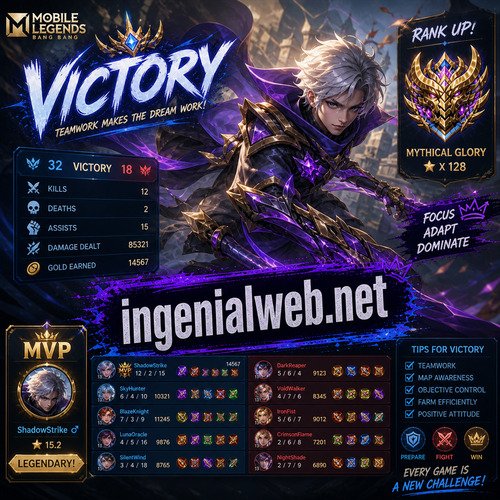
ingenialweb.net – Mobile Legends is a game that rewards far more than mechanical skill. While quick reactions and accurate ability usage are certainly valuable, long-term success is usually determined by strategy, teamwork, awareness, and decision-making. Every match presents players with dozens of opportunities to gain advantages, recover from setbacks, and create winning conditions. Understanding how to recognize and act upon those opportunities is what separates average players from truly effective competitors.
One of the reasons Mobile Legends remains popular across different regions is its balance between accessibility and depth. New players can quickly learn the controls and basic objectives, but mastering the game requires a much deeper understanding of map management, resource allocation, hero synergy, and objective control. The game constantly challenges players to adapt to changing situations while coordinating with teammates who may have different playstyles and priorities.
Many players believe that reaching higher ranks is simply a matter of improving mechanics. While mechanics help during fights, they do not guarantee victory. A mechanically gifted player who consistently makes poor strategic decisions may struggle to win games. On the other hand, a player with solid fundamentals and strong decision-making often contributes significantly even without flashy plays.
The key to consistent improvement is understanding how every part of the game connects. Farming influences item progression, item progression affects team fights, team fights create opportunities for objectives, and objectives ultimately determine victory. Players who recognize these relationships are better equipped to make decisions that support long-term success rather than chasing short-term rewards.
Building a Strong Foundation During the Early Game
The opening phase of a match often determines how much freedom a team will have later. While comebacks are always possible, establishing a solid foundation creates opportunities that make future decisions easier.
Resource management begins from the moment the match starts. Every minion wave, jungle camp, and objective contributes toward a hero’s overall strength. Players who consistently gather resources effectively often gain significant advantages over opponents who neglect farming.
Efficiency is not simply about collecting resources as quickly as possible. It also involves minimizing wasted movement and maximizing productive actions. Strong players rarely spend time wandering without purpose. Instead, they move deliberately between objectives, waves, and opportunities.
One common mistake among developing players is prioritizing risky fights over guaranteed income. Chasing an enemy across the map may occasionally result in a kill, but it can also lead to lost waves, missed objectives, and unnecessary exposure. Smart players understand that steady progression often provides more value than unpredictable aggression.
As the match continues, even minor differences in resource collection become increasingly important. Heroes with stronger item progression can influence fights more effectively and create greater pressure across the map.
Understanding the Importance of Lane Discipline
Lane discipline is one of the most underrated aspects of Mobile Legends. Many players focus heavily on combat while overlooking the strategic importance of managing waves and maintaining favorable lane conditions.
Strong lane discipline involves balancing aggression and caution. Players must understand when to pressure opponents and when to prioritize safety. Overextending without information can create opportunities for enemy rotations, while excessive passivity may allow opponents to control the pace of the lane.
Wave management also plays a critical role. Properly timed pushes can force opponents to respond, creating opportunities elsewhere on the map. Meanwhile, poorly managed waves can lead to lost resources and reduced pressure.
By maintaining lane discipline, players contribute not only to their own success but also to the strategic stability of the entire team.
Establishing Awareness Habits Early
Map awareness should begin from the opening moments of a match and continue throughout every stage of play. Information gathered from the minimap often provides more value than any single mechanical outplay.
Players who regularly observe the minimap gain a better understanding of enemy movements and potential threats. This awareness allows them to avoid ambushes, anticipate rotations, and identify opportunities before they become obvious.
Awareness also helps players make smarter strategic decisions. Recognizing that multiple opponents are visible on one side of the map may create opportunities to secure objectives elsewhere. Understanding these patterns transforms information into actionable advantages.
Consistent awareness reduces uncertainty and allows players to operate with greater confidence and efficiency.
Controlling the Mid Game Through Strategy and Coordination
The mid game is often where strategic differences become most apparent. Teams begin contesting larger objectives, rotating more frequently, and seeking opportunities to expand their influence across the map.
Many matches are decided not by dramatic moments but by the accumulation of small advantages. A successful rotation, an efficiently cleared wave, or a well-timed objective capture may seem insignificant individually, but together they create meaningful momentum.
Strong teams understand how to build upon success. After winning a fight, they immediately consider what additional gains can be secured. Rather than focusing solely on the elimination itself, they look for opportunities to destroy structures, secure resources, or establish map control.
This approach creates a cycle of progression where each success contributes to future opportunities. Over time, these incremental gains become increasingly difficult for opponents to overcome.
The ability to recognize and capitalize on opportunities is one of the defining characteristics of effective players.
Prioritizing Objectives Over Unnecessary Engagements
While combat is an exciting part of Mobile Legends, objectives remain the true pathway to victory. Teams that consistently prioritize objectives often outperform opponents who focus primarily on fighting.
Turrets provide territorial control and restrict enemy movement. The Turtle offers economic benefits that accelerate progression. The Lord creates immense pressure capable of breaking defensive positions.
Understanding objective priority helps players allocate their time more effectively. Instead of chasing low-value engagements, they focus on actions that produce lasting strategic benefits.
This objective-oriented mindset often results in more consistent performance and stronger overall decision-making.
Coordinating Team Movements
Coordination becomes increasingly important as matches progress. Individual skill remains valuable, but teamwork often determines whether opportunities are successfully converted into advantages.
Effective coordination involves understanding where teammates are positioned and how their actions influence the broader strategy. Players who move together can create numerical advantages, secure objectives more safely, and respond more effectively to threats.
Communication, whether through direct messages or in-game signals, further enhances coordination. Teams that share information efficiently often make faster and more accurate decisions.
By aligning individual actions with team objectives, players contribute to a more cohesive and effective overall strategy.
As players gain experience, advanced concepts become increasingly important. These principles often separate consistent performers from those who struggle with inconsistency.
Positioning as a Competitive Advantage
Positioning affects nearly every aspect of gameplay. It influences survivability, damage output, objective control, and team fight effectiveness.
Good positioning allows players to contribute while minimizing exposure to danger. Different roles require different positioning priorities, but every player benefits from understanding how location influences effectiveness.
Positioning should also be proactive rather than reactive. Establishing favorable locations before fights begin often creates significant advantages. Teams that control important areas of the map can dictate engagement conditions and force opponents into less favorable situations.
Consistent positioning discipline leads to better outcomes across a wide variety of scenarios.
Adapting to Changing Conditions
Adaptability is essential because no two matches unfold exactly the same way. Enemy compositions, player behavior, and objective situations constantly create new challenges.
Players who remain flexible can adjust their strategies according to current conditions. This may involve changing item builds, modifying rotational patterns, or altering engagement priorities.
Adaptability requires awareness and critical thinking. Rather than relying on predetermined plans, successful competitors continuously evaluate the battlefield and make adjustments as needed.
This ability to respond effectively to change often determines long-term success.
Maintaining Mental Consistency
Competitive environments naturally create pressure. Mistakes, setbacks, and difficult matches are inevitable. How players respond to these challenges often influences future performance.
Mental consistency involves remaining focused regardless of circumstances. Instead of dwelling on previous mistakes, strong players concentrate on identifying the next productive action.
This mindset improves decision-making and reduces the likelihood of emotional reactions that lead to poor choices. Over time, mental resilience becomes a valuable competitive asset.
Players who maintain composure are often better equipped to perform consistently during both favorable and unfavorable situations.
Developing a Long-Term Improvement Mindset
Improvement in Mobile Legends rarely occurs overnight. Meaningful progress usually results from gradual refinement of habits and decision-making processes.
The most successful players approach every match as a learning opportunity. They analyze mistakes, identify patterns, and seek ways to improve. Rather than focusing exclusively on immediate outcomes, they prioritize long-term development.
This growth-oriented mindset encourages continuous adaptation and prevents stagnation. As knowledge and experience accumulate, performance naturally improves.
Commitment to learning remains one of the most reliable pathways toward competitive success.
Conclusion Mobile Legends Tactical Guide: How to Improve Decision-Making, Team Coordination, and Overall Match Performance
Mobile Legends is a game where success emerges from the combination of mechanics, strategy, awareness, and teamwork. While individual skill can influence specific moments, consistent victories are typically achieved through disciplined decision-making and strong fundamentals.
Players who prioritize efficient resource collection, maintain lane discipline, develop map awareness, and focus on objectives create conditions that support long-term success. As they continue improving, advanced concepts such as positioning, adaptability, coordination, and mental resilience become increasingly important.
The journey toward mastery involves understanding how each element of the game contributes to overall performance. Every match provides opportunities to refine existing skills and develop new ones. By approaching the game strategically and embracing continuous improvement, players can steadily increase their impact and achieve greater success.
Ultimately, Mobile Legends rewards those who think beyond immediate outcomes and focus on the broader strategic picture. Through consistent learning, intelligent decision-making, and effective teamwork, players can unlock their full potential and enjoy a deeper, more rewarding competitive experience.
